
Trade show lead generation with a prize wheel
How to use a prize wheel to generate leads at a trade show: the visitor journey, what data to ask for, how to get consent and how to follow up.
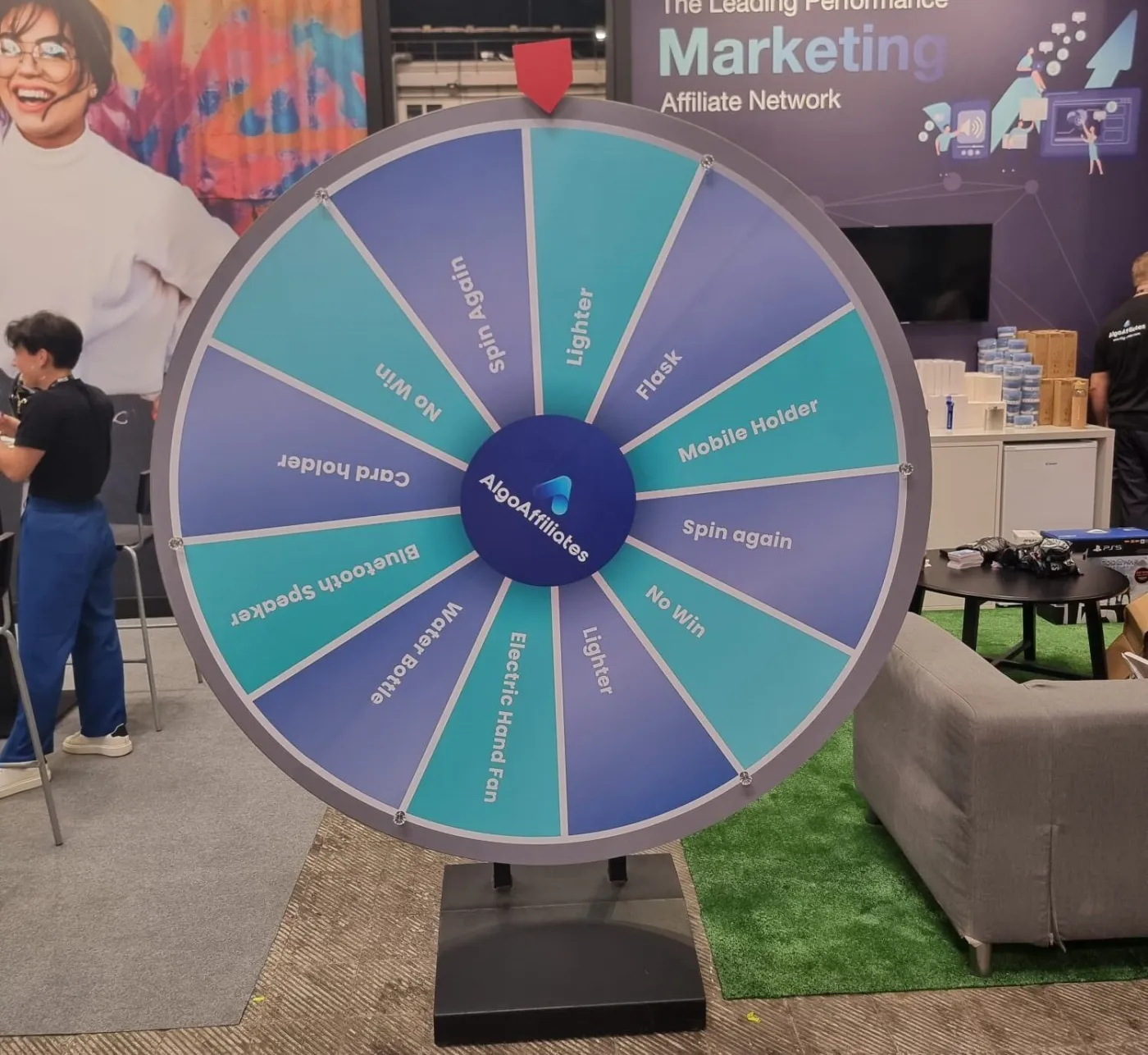
At a trade show, everyone wants the same thing: for people to stop at their stand and to leave having shared their details. A prize wheel is one of the most effective ways to achieve the first, and if it is well organised, the second too. The usual mistake is to think that putting a wheel out and waiting is enough. What makes the difference is the visitor's journey from the aisle to the prize, and what you do with their details when you get back to the office. Here is a step-by-step method for trade show lead generation with a prize wheel.
Step 1: define a good lead
Before the show, agree with your sales team what a worthwhile contact looks like. A student is not the same as a purchasing manager. That definition shapes which prizes you offer, which questions you ask and how much time you spend with each visitor. If volume is all that matters, any prize will do; if you want qualified leads, the top prize should appeal mainly to your ideal customer.
Step 2: put the wheel where it can be seen
- At the front of the stand, not at the back. The wheel is the draw and has to be visible from the aisle.
- Without blocking the entrance. Leave room for people who want to talk to your team without playing.
- With space in front: at least a metre for the person spinning and a bit more for onlookers.
- With the top prize on show, next to the wheel or in a display case.
On most stands the 120 cm floor-standing wheel fits well, at around 120 × 190 × 60 cm. On large stands or in busy halls, the 180 cm wheel can be seen from much further away. Always check the maximum height the show allows.
Step 3: design the visitor journey
The ideal journey is short and always in the same order:
- Attract: the wheel, the click and people watching make someone stop.
- Invite: someone on the stand offers them a go. A simple line works better than a pitch.
- Register: they leave their details on a tablet or via a QR code. Keep the form short.
- Spin: the fun part. Do not drag it out.
- Hand over and talk: while they collect their prize, your team asks one or two questions about their interests.
- Note it down: a quick mark on the record (hot, warm, cold) for follow-up.
Step 4: ask for little and get consent right
The more fields a form has, the fewer people fill it in. For most shows, this is enough:
- Name.
- Company and job title.
- Email or phone number.
- One qualifying question: “What interests you most?” with three or four options.
Most important of all: consent. Under data protection rules (GDPR in Europe) you must tell people who is processing their data and why, and ask their permission clearly. In practice:
- An unticked box to agree to receive marketing. Never pre-ticked.
- A short note saying who the data controller is, what the data will be used for and where to read the full privacy policy.
- Where possible, keep permission to play separate from permission to receive marketing.
- Keep only the data you will actually use, and no longer than necessary.
If you are unsure about the wording or about making the game conditional on sharing details, check with your data protection officer or adviser. And if the wheel is part of a prize promotion open to the public, check whether you need formal terms and conditions too.
Step 5: choose prizes that filter
- Small prizes for everyone: useful merchandise that goes home with people and keeps your brand in mind.
- A top prize related to your product: a free trial, an audit, a tailored demo. That way the prize attracts people who could genuinely become customers.
- Question segments: a question about your industry opens a conversation naturally.
Avoid making the top prize an expensive gadget unrelated to your business: you will attract freebie hunters who are never going to buy.
Step 6: organise the team
A wheel on a stand works best with two clear roles: someone who invites people and runs the game, and someone from sales who talks to the promising visitors. If your sales team is stretched, you can have a host or entertainer run the wheel; United Events has staff for exactly that and we can suggest someone if you need it. That way your salespeople talk to customers instead of handing out T-shirts.
Step 7: follow up within 48 hours
Most trade show leads go cold because nobody calls them in time. Before the show, prepare:
- A thank-you email ready to send when you get back, mentioning what was discussed on the stand.
- A plan for sharing the hot leads among the sales team.
- A way to measure it: how many spins, how many sign-ups, how many meetings and how many sales come out of the show.
Multi-day shows
If the show runs for several days, hiring the wheel by the day or by the week is the most practical option. We take care of delivery, set-up and collection, and branding is included. We need the design at least two weeks in advance. There is more information on prize wheel hire and trade show prize wheel.
Frequently asked questions
Can I ask for an email address in exchange for a spin?
It is a very common approach. Explain clearly what you will use the data for and ask for consent with an unticked box. If you have any legal doubts, check with your adviser.
How many people can play in an hour?
It depends on how long registration and the conversation take. With a short form, a few dozen an hour. If you expect a crowd, consider two wheels or two registration points.
Can you send someone to run it?
Hire does not include staff, but we can suggest someone. Request a quote here.
Prize wheels in this article
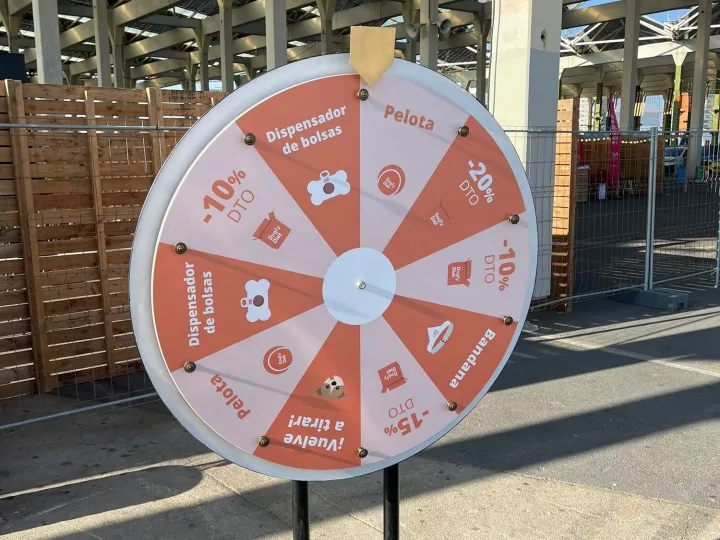
120 cm custom floor-standing prize wheel
A real, physical prize wheel that fits on any stand and in any lift
- Dimensions 120 × 190 × 60 cm (W × H × D) · artwork about 110 cm across
- Stand Black stand, on wheels or feet depending on the venue
- Access Fits standard lifts · two people to move it
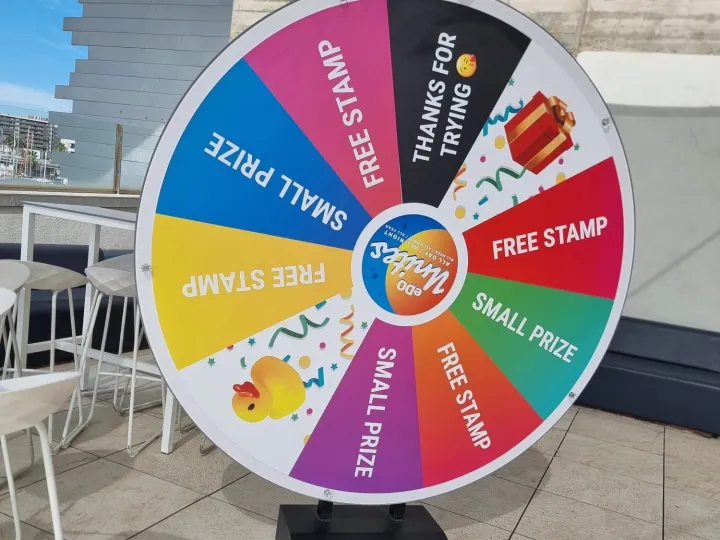
180 cm custom giant prize wheel
Our biggest prize wheel, so your brand is seen from across the hall
- Dimensions 180 × 220 × 60 cm (W × H × D)
- Stand Metal base that sits on the floor
- Access Goods lift or street-level access, no stairs or narrow corridors (220 cm long)
Want a prize wheel at your event?
We tell you which wheel fits best, how many prizes you need and how to brand it with your logo.