
Physical vs digital prize wheel at a stand
Physical or digital prize wheel at a trade show stand: what each one offers, when each wins and how to combine them to draw a crowd and collect data.
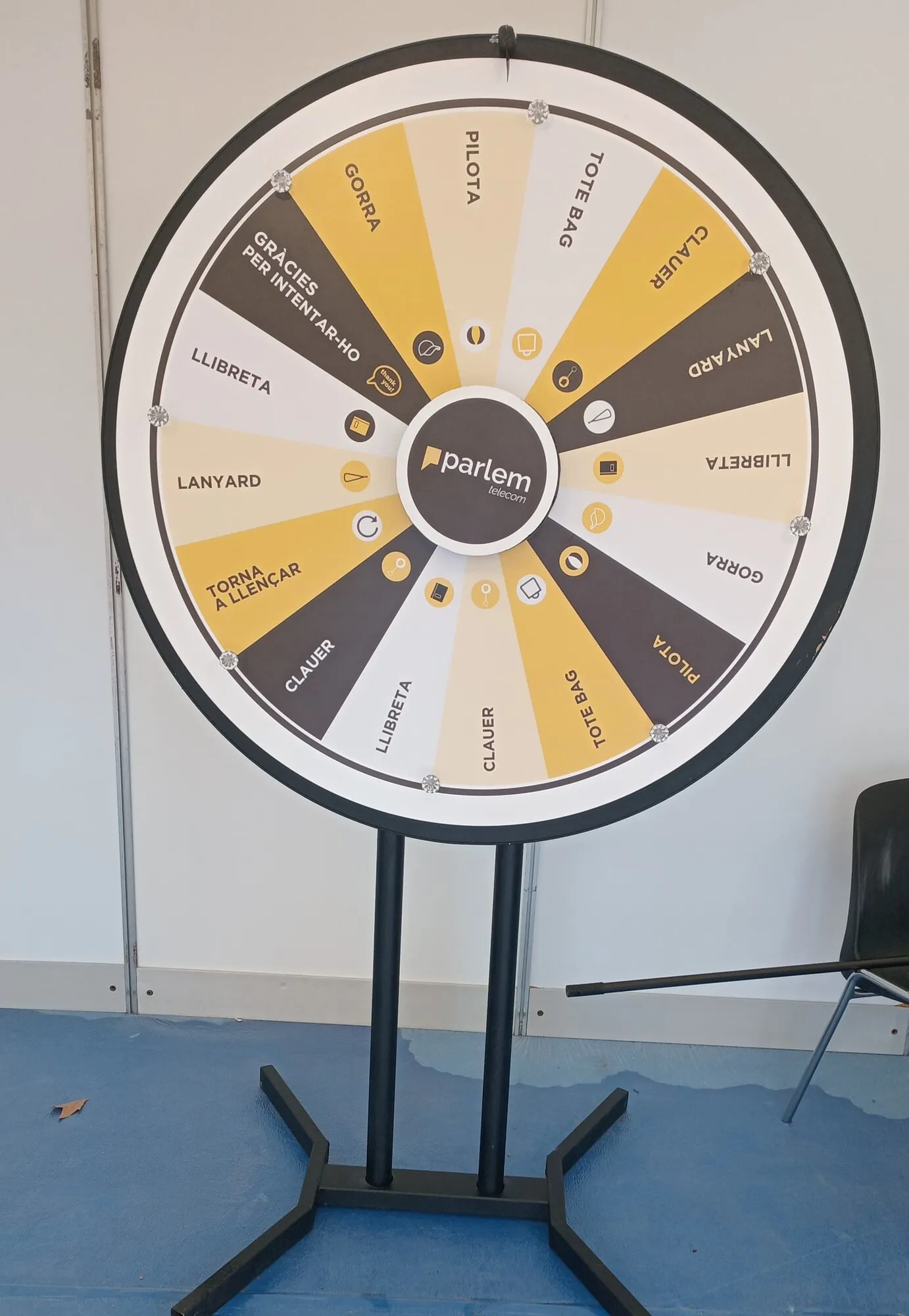
If you are looking for a prize wheel for your stand, you will find two worlds online: physical wheels, which you spin by hand, and digital wheels, which spin on a screen or a phone. Both can be used to give away prizes, but they do not do the same job in a trade show aisle. We work with physical wheels, so we are not neutral, but we are honest: there are cases where a digital one is a better fit. In this article we explain what each one brings and how to decide.
What a physical wheel brings
- It is visible from afar. A colourful wheel 120 or 180 cm across, carrying your brand, is a draw that people understand from the aisle without reading a word. A screen competes with every other screen in the hall.
- It makes a sound. The click-click of the flapper against the pegs on the rim can be heard several metres away and builds suspense. As the wheel slows, everyone walking past turns to see where it stops.
- It is hands-on. Spinning by hand has a funfair feel that a touchscreen lacks. People feel the result depends on their spin, and that is addictive.
- It gathers a crowd. Every spin is a small show: someone spins, others watch and cheer. A group in front of the stand attracts more people.
- It does not rely on technology. No socket, wi-fi or battery needed, and it never crashes. At a show with an overloaded network, that matters.
- It shows up in photos. A big wheel with your logo appears in the photos visitors take and in the ones you post afterwards.
What a digital wheel brings
- Built-in data capture. The form and the game sit together, and the data goes straight into a database.
- Precise prize control. You can set stock levels, hourly limits and exact odds.
- Instant changes. Prizes, wording or language can be edited in a minute.
- No space or transport. All you need is a screen or the visitor's phone.
- It works remotely. People can play on a website or on social media, away from the event.
When each one wins
Physical wins if…
- Your problem is that people do not stop at the stand.
- You want atmosphere: noise, groups, laughter and photos.
- Your audience is mixed and not everyone will take out a phone or fill in a screen.
- The event is outdoors, in a shop, at a party or somewhere with a poor connection.
- You want your brand to be seen big and from afar.
Digital wins if…
- Your absolute priority is collecting data and footfall is already guaranteed.
- You need prizes with very limited stock and exact control per time slot.
- The campaign is online or played from home.
- You have no space at all on the stand.
The best of both: combine them
At many trade shows a simple mix works well: the physical wheel draws people in and entertains them, and data is collected separately, with a tablet or a QR code. The typical flow looks like this:
- The wheel, clearly visible at the front of the stand, catches the eye.
- Anyone who wants to play leaves their details on a tablet or scans a QR code with a short form.
- They spin the wheel and collect their prize.
- Your team uses those few seconds to start a conversation.
That way you get the pull of a physical wheel and the tidy data of a digital one. And if the form asks about the person's real interest, your sales team will know who to call first. We go into more detail in trade show lead generation with a prize wheel.
What about the odds for each prize?
This is the big advantage people credit to digital wheels, but a physical wheel lets you organise the odds too, transparently. Every segment of the same size has the same chance. If you want a prize to come up more often, repeat it across several segments; if you want it to come up less, give it just one. And for a top prize with few units, the segment can give an entry into a final draw rather than the prize itself. Everyone can see the wheel, and that builds trust.
Common mistakes with a wheel on a stand
- Hiding it at the back, behind the counter. If it cannot be seen from the aisle, it attracts nobody.
- Leaving it unattended. A wheel with nobody inviting people to play just sits there. You need someone to run it.
- Asking for too much data before the spin. Every extra field means more people walking away.
- Covering it in text. One or two words per segment; everything else on a sign next to it.
Questions to help you decide
- What are we missing most: people who stop, or data from the people who already do?
- How much space do we have at the front of the stand?
- Does the venue have a good connection and a socket where the game will go?
- Do we want atmosphere and photos, or a low-key activity?
- Who will be on the stand to run the game?
If you want to see how one of our wheels spins, slows down and is set up, we explain it in how a prize wheel works. For specific stand ideas, see trade show prize wheel.
Frequently asked questions
Does a physical wheel need electricity?
No. It spins by hand on an axle and the flapper slows it down gradually. There is nothing to plug in.
Can you collect data with a physical wheel?
Yes, with a separate form: a tablet or a QR code. The wheel is the draw and the reward; the details are collected before the spin, always with the person's consent.
Which size of physical wheel works best on a stand?
On most stands, the 120 cm wheel. In large halls or on big stands, the 180 cm one. If you are unsure, ask us for a quote and we will advise you.
Prize wheels in this article
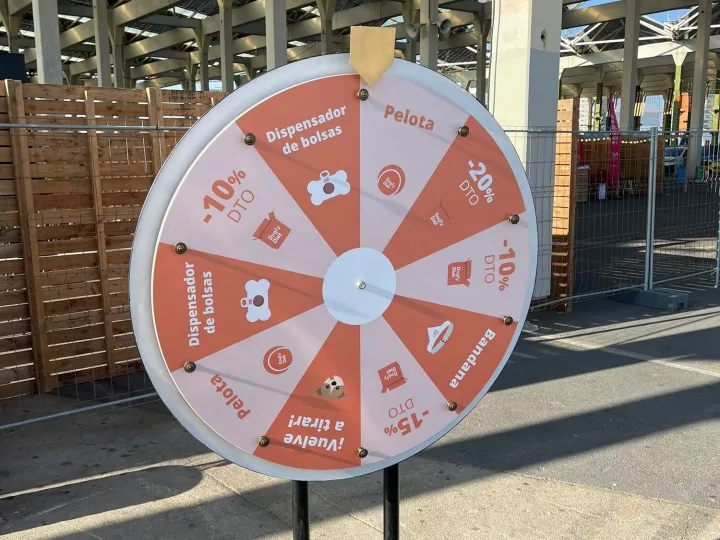
120 cm custom floor-standing prize wheel
A real, physical prize wheel that fits on any stand and in any lift
- Dimensions 120 × 190 × 60 cm (W × H × D) · artwork about 110 cm across
- Stand Black stand, on wheels or feet depending on the venue
- Access Fits standard lifts · two people to move it
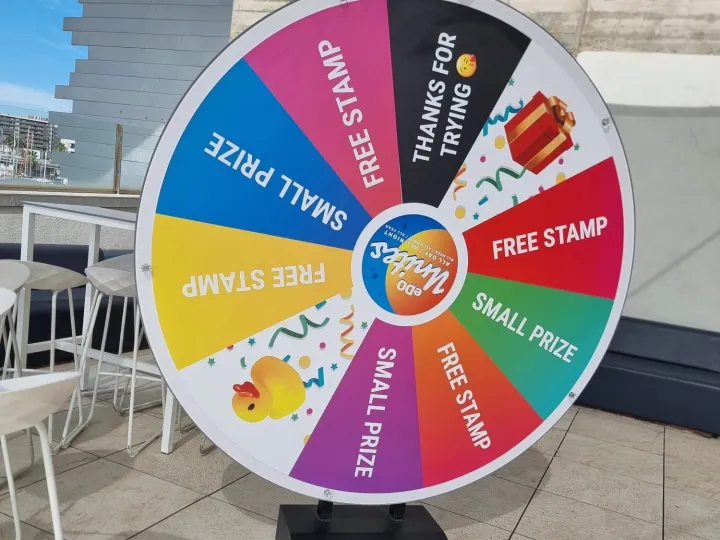
180 cm custom giant prize wheel
Our biggest prize wheel, so your brand is seen from across the hall
- Dimensions 180 × 220 × 60 cm (W × H × D)
- Stand Metal base that sits on the floor
- Access Goods lift or street-level access, no stairs or narrow corridors (220 cm long)
Want a prize wheel at your event?
We tell you which wheel fits best, how many prizes you need and how to brand it with your logo.